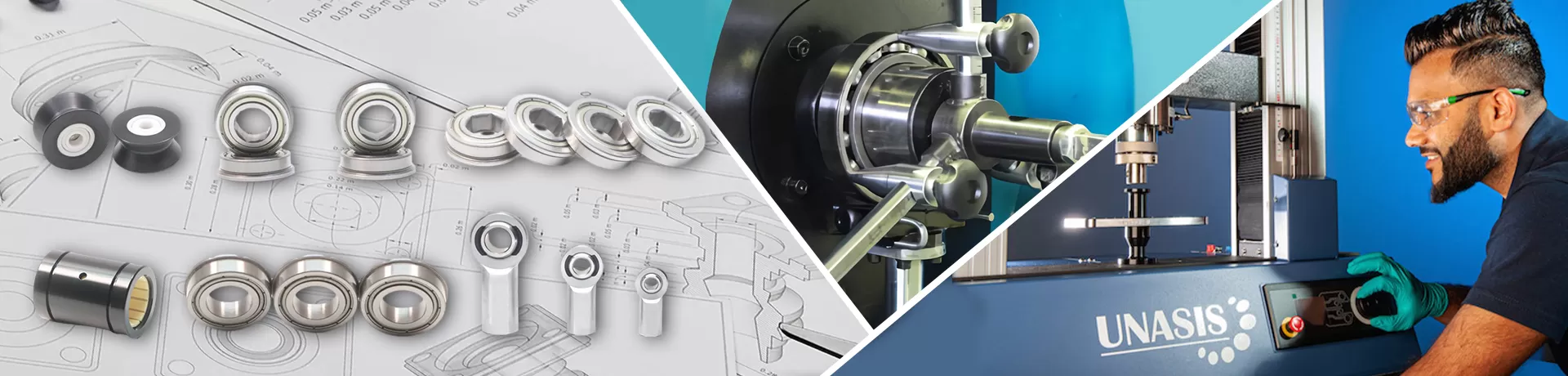
Bearing Catalog
Machine tool bearings are vital components in machine tool equipment, mainly used to support the rotary axis, reduce friction and ensure high precision, high stability and long life of the machine tool. With the modern manufacturing industry's ever-increasing requirements for machining accuracy and efficiency, the performance of machine tool bearings directly affects the overall performance of the machine tool. The following is a detailed introduction to machine tool bearings:
1. Classification of machine tool bearings
Machine tool bearings are mainly divided into the following categories according to their structure and working principle:
Rolling bearings: including deep groove ball bearings, angular contact ball bearings, cylindrical roller bearings and tapered roller bearings. Rolling bearings have the advantages of high speed, low friction and high load carrying capacity, and are widely used in all kinds of machine tools.
Sliding bearings: reduce friction by forming an oil film between the shaft and the bearing by means of a lubricant. Sliding bearings are suitable for high-precision, low-speed occasions, such as grinding machine spindles.
Hydrostatic bearings: support the shaft through the external pressure oil film to realize contactless operation, with very high rigidity and precision, commonly used in high-precision CNC machine tools.
Magnetic levitation bearings: the use of magnetic levitation shaft, to achieve contactless, frictionless operation, suitable for ultra-high speed, ultra-high precision machine tools and equipment.
2. Characteristics of machine tool bearings
High precision: the manufacturing precision of machine tool bearings directly affects the machining accuracy of the machine tool, usually requires the dimensional tolerance and rotational accuracy of the bearing to reach the micron level.
High rigidity: bearings need to have enough rigidity to withstand cutting forces, vibration and shock, to ensure the stability of the machine tool.
Long life: machine tool bearings need to have good wear resistance and fatigue resistance to extend service life and reduce downtime for maintenance.
Low friction: A low-friction design reduces energy loss and improves machine efficiency and smoothness of operation.
High temperature: machine tools in high-speed operation will generate heat, bearings need to have good high temperature resistance to ensure stable work in high temperature environments.
3. Application of machine tool bearings
Machine tool bearings are widely used in various types of machine tools, including:
Lathe: used to support the spindle and tailstock to ensure the rotational accuracy of the workpiece.
Milling machine: used to support the spindle and feed system to realize high-precision cutting.
Grinding machine: Used to support the grinding wheel spindle to ensure grinding accuracy and surface quality.
CNC machine tools: used to support high-speed spindle and precision feeding system to meet the processing needs of complex parts.
4. Selection of machine tool bearings
Selection of suitable machine tool bearings need to consider the following factors:
Speed: high speed occasions need to choose low-friction, high-precision bearings.
Load: according to the cutting force and vibration of the machine tool, select the bearing with sufficient load capacity.
Precision requirements: high-precision machine tools need to choose high-precision grade bearings.
Working environment: consider the temperature, humidity and pollution and other factors, select the appropriate bearing materials and lubrication.
5. Maintenance of machine tool bearings
In order to ensure the performance and life of machine tool bearings, the need for regular maintenance:
Lubrication: choose the appropriate lubricant, regular replenishment or replacement to reduce friction and wear.
Cleaning: keep the bearings and their surrounding environment clean, to prevent contaminants from entering the internal bearing.
Inspection: Regularly check the running status of the bearings to find and deal with abnormalities in time.
6. Market trends
With the advancement of intelligent manufacturing and Industry 4.0, machine tool bearings are developing in the direction of high precision, high speed, high reliability and intelligence. For example, smart bearings with integrated sensors can monitor the status of bearings in real time, realize predictive maintenance, and improve the operating efficiency and reliability of machine tools.
Summarize
Machine tool bearings as the core components of the machine tool, its performance directly affects the machining accuracy, efficiency and life of the machine tool. Through reasonable selection, correct installation and regular maintenance, the performance of machine tool bearings can be fully utilized to provide strong support for modern manufacturing. With the continuous progress of technology, machine tool bearings will continue to play an important role in the field of high-end manufacturing.
Contact Us
Related Product
30x55x13 Bearing6013 2RS Bearing90x140x24 Bearing6011 2RS Bearing6002 2RS Bearing6015 Bearing Price6004 2RS Bearing6017 Bearing6844-2RS Bearing6848 Bearing6019 Bearing6022 Bearing6014 2RS BearingFR168 Bearing6012 RS Bearing6836 ZZ Bearing6005 2RS Bearing6026 2RS Bearing6020 2RS Bearing6836 Bearingbearings for small electric motors6011 Bearing6000RS Bearing6026 Bearing6015 BearingF6800ZZ BearingF6801 Bearing6012 2RS Bearing6008z BearingAutomation equipment bearing solutions6002ZZ Bearing6024 ZZ Bearing6004 2RS Ball Bearing6010 Bearing606 2RS Bearing6834 2RS BearingCrane Bearings6838 Bearing6848-2RS Bearing20x42x12 Bearing6016 2RS Bearing609 2RS Bearing6830 Bearingceramic bearings for electric motors6004z Bearing